

You can run a tournament with any game that gives a score, plus a shared note or group chat to record results. You don't need special software or a leaderboard, and it works whether you're all in one room or playing from different places.
Step 1: Pick a game with a clear score
A good tournament game is quick, easy to explain and ends with a number everyone can compare. Listed score-based options on Funplay include:
Road 66: survive as long as you can and beat the high score.
Jungle 2048: merge numbers and aim as high as you can.
Mad Mac: cover the farthest distance you can.
Everyone should play on a similar footing. If your group mixes phones and computers, try a game round first to check that nobody has a big advantage.
Step 2: Choose a format
The right format depends mostly on how many people are playing and how much time you have.
| Format | How it works | Rounds or matches needed | Best for |
|---|---|---|---|
| Score attack | Everyone plays separately, and the highest score wins | 1 to 3 attempts each | Any group size, especially remote |
| Round robin | Everyone plays everyone once | 6 matches for 4 players, 28 for 8 | Small groups with time |
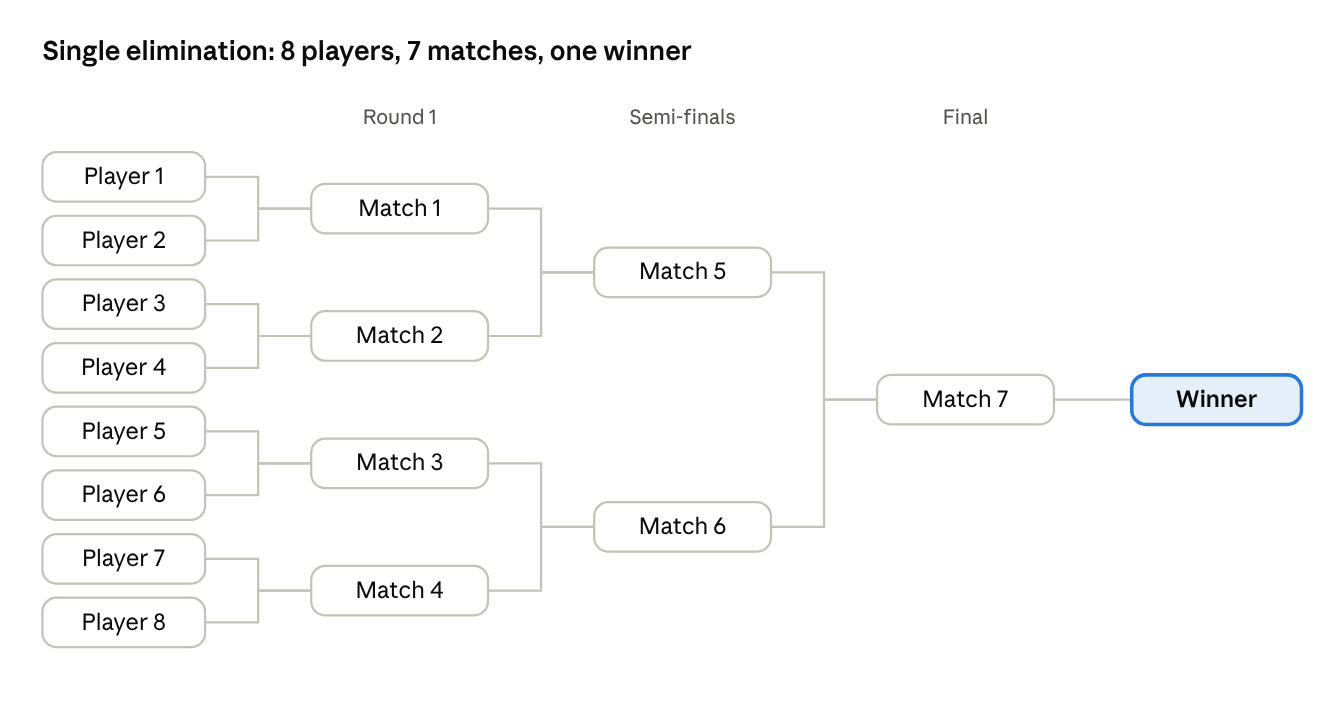
| Single elimination | Lose once and you're out | 7 matches for 8 players | Quick finish with a final |
| Swiss | Players with similar scores meet, and nobody is knocked out | 3 rounds for 8 players | Bigger groups who all want to keep playing |
The formal chess version of Swiss has detailed rules, but its core is simple: FIDE's Swiss rules say participants generally face others with the same score, and no two should play each other more than once.
For most friend groups, we'd suggest score attack. Nobody has to be online at the same time, and nobody gets knocked out early.
Step 3: Set the rules before you start
Agree on these and write them down:
The game and mode. Everyone should play the same one.
The number of attempts. Three attempts with your best score counting is a fair default.
The deadline. For example, "scores in the chat by 9 pm on Friday".
The proof. A screenshot of each final score keeps things friendly.
The tie-breaker. A single extra attempt is the simplest way to settle it.
Step 4: Run it
Keep a simple table in a shared note, with one row per player and one column per attempt. Post updates as scores come in, because seeing a rival's score is half the fun. If you're together in person, let people watch each other's final attempts.
Step 5: Finish properly
The winner deserves a moment. Keep the prize small and silly: the winner picks the next game, or the loser buys the coffee. Don't play for real money, since that can bring legal issues and quickly spoils the fun.
Ways to keep it fair and fun
Give beginners a chance. Use a "most improved" award, comparing each person's first attempt with their best.
Rotate the game. A new game each week stops one player from winning everything.
Run short seasons. Award points for each event, then crown a champion after four rounds.
Keep it light. If someone gets too serious about it, it's time to pick a sillier game.
Start your first tournament
Choose a game, set a deadline and send the link to your group. New to competitive play? Our beginner's guide to competitive casual gaming explains the basics. If you pick Jungle 2048, the corner strategy guide might give you an edge, so don't share it too soon.
Sources
FIDE Handbook, C.04.1 Basic rules for Swiss Systems, effective February 1, 2026.
Funplay game listings for Road 66, Jungle 2048 and Mad Mac.
The match counts are simple arithmetic, and the setup advice is our own.