
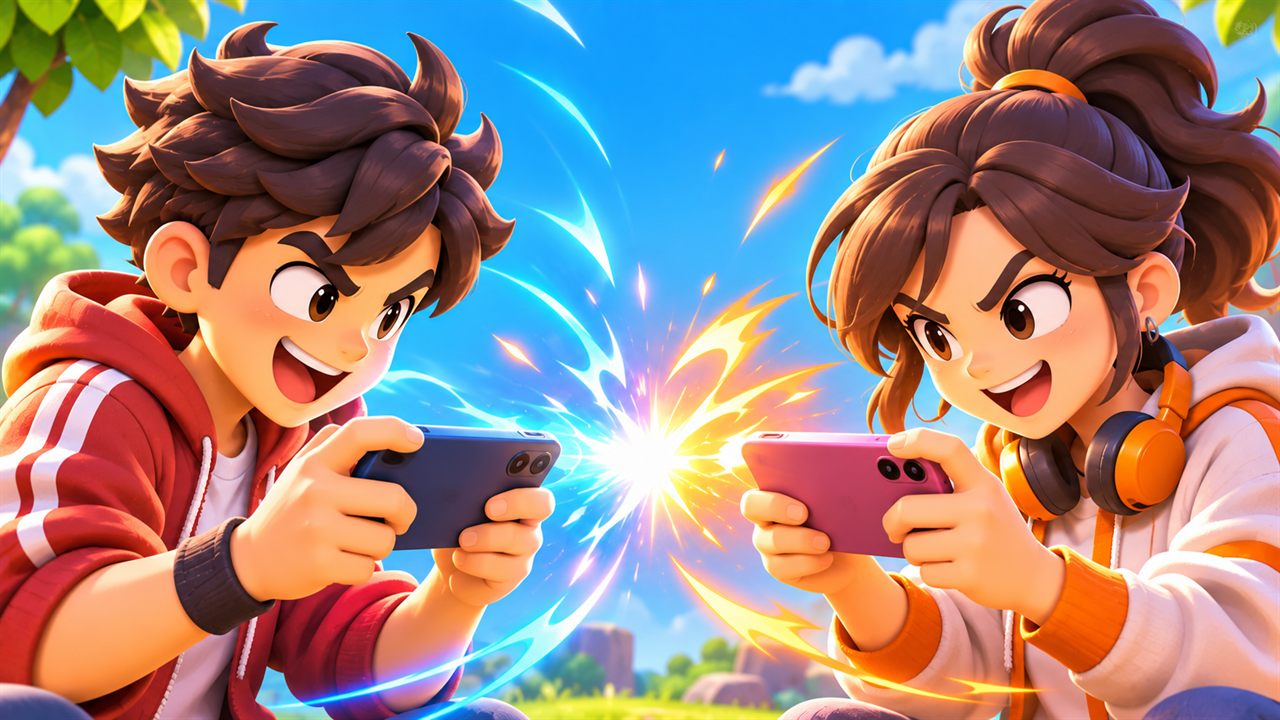
Competitive casual gaming means playing simple games against other people, or against their scores, in short rounds. You don't need a gaming PC, a team or hours of practice. You need a few minutes and a wish to beat somebody.
The idea isn't new. Anyone who has fought over a high score on an arcade machine has done it. What has changed is that the same contest now fits on a phone.
Simple games can reach serious levels of play too. In 2024, 404 Media reported that a 13-year-old had become the first known human to reach the kill screen in NES Tetris. For more examples, read the rise of casual esports.
What makes a game "competitive casual"
There's no official definition, but most of these games share four traits:
Rules you can learn in seconds. If a game needs a long tutorial, it's probably not casual.
Short rounds. A match takes minutes, so losing doesn't cost you an evening.
A real measure of skill. Better players should win more often, even when the game looks simple.
Someone to beat. That might be a live opponent, a leaderboard or your own best score.
How it differs from esports
Esports titles reward deep knowledge. Players study maps, characters and team tactics, and they often practice together for long hours. Competitive casual games move that contest into a smaller space. You can be useful in your first match, and you can stop after one round without letting anyone down.
That doesn't make them easy to master. Matching tiles quickly or reading a bouncing ball takes real practice. The difference is that the first step is small.
The main ways to compete
Head-to-head rounds. You and an opponent play at the same time, and the better result wins. In Mahjong Legends, each round gives you 2 minutes to match as many tile pairs as you can against a new opponent. Miner Mayhem applies the same 2-minute idea to a brick breaker battle.
Leaderboards. Wins or scores place you on a ranking, so every round counts toward something bigger. In Mahjong Legends, you collect battle points with each win to climb the table.
Solo or versus. Some games let you choose. Thor's Merge and Snake Maxx both offer solo play as well as PvP, which is useful when you want to learn the game before facing anyone.
Beating your own score. Games such as Road 66 ask you to survive as long as you can and beat the high score. Your strongest rival may be yesterday's you.
Why people enjoy it
A close result is exciting whether a match lasts two minutes or two hours. Short rounds also make it easy to try again straight after a loss, while you still remember what went wrong. And progress is easy to see, because the number either went up or it didn't.
How to get started
Pick a game you already understand. Tile matching and snake games are familiar to many players, so you can focus on improving.
Play solo first if you can. A few practice runs teach you the controls without any pressure.
Try one versus round. Expect to lose a few. You'll learn what stronger players do differently.
Change one habit at a time. For example, look ahead one move further, or slow down to avoid mistakes.
Stop while it's fun. Short rounds are easy to repeat, so set a limit before you start.
Is it for you?
If you like improving at something but don't have long stretches of free time, it may suit you well. Browse the battle games, choose one and play a single round. You'll know quickly whether you want another.
Sources
404 Media, 13-Year-Old Becomes First Person to Ever Beat Tetris, January 2, 2024.
Funplay game listings for Mahjong Legends, Miner Mayhem, Thor's Merge, Snake Maxx and Road 66.
The definition and the getting-started advice are our own, as there's no official definition of the term.