
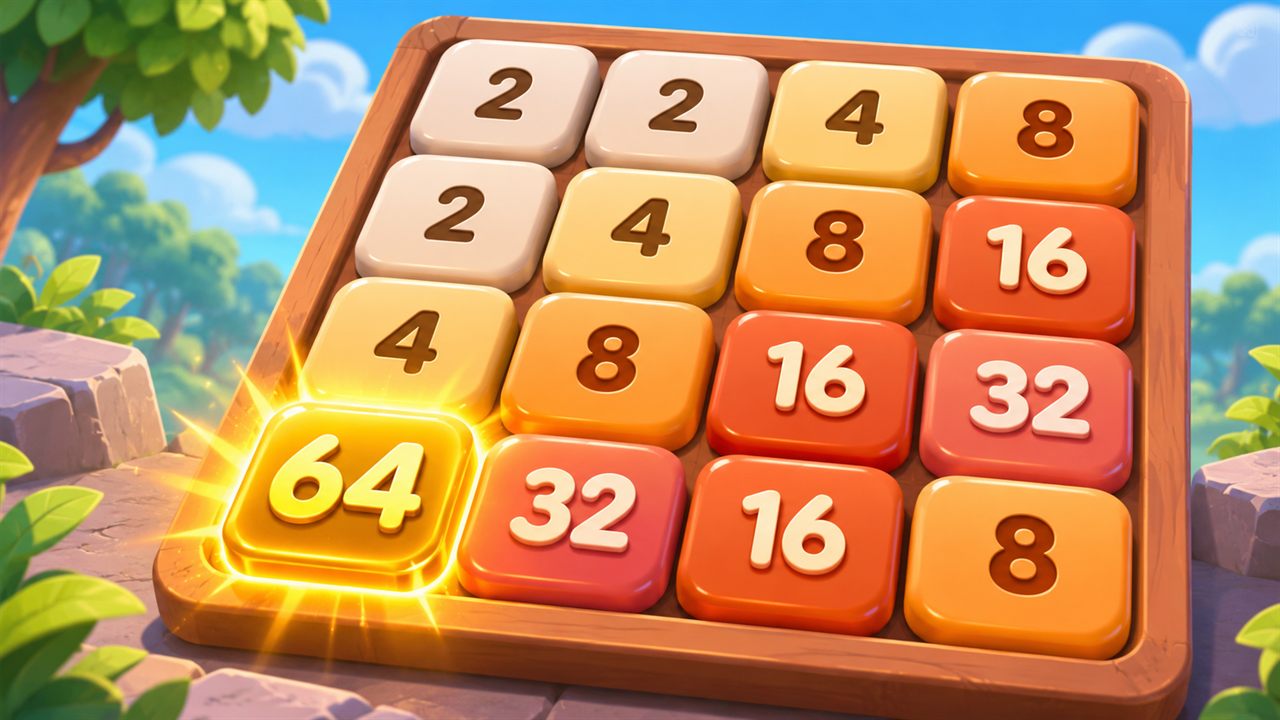
The most reliable way to improve at 2048 is to keep your highest tile in one corner and build everything around it. This one habit turns a board that fills up at random into one you can plan.
These tips are written for the classic game, and they apply to number merging games such as Jungle 2048.
A quick recap of the rules
Each move slides every tile on the board in one direction. When two tiles with the same number collide, they merge into one tile worth double. After each move, a new low-value tile appears in an empty space. The game ends when the board is full and no merge is possible.
That last rule is the key: empty space is what keeps you alive. Every tip below helps you keep space and keep your tiles in merging order.
The corner strategy in 5 steps
1. Choose a corner and stay with it. Bottom left is a popular choice, but any corner works. Your highest tile lives there for the rest of the game.
2. Limit your directions. With a bottom-left corner, mostly move left and down. Move right only when those two are blocked. Avoid moving up whenever you can, because it can pull your biggest tile out of the corner.
3. Keep the bottom row full. A full row can't shift sideways, so your corner tile stays safe when you move left or right. This makes the row a stable base for the rest of the board.
4. Build a descending chain. Arrange the row in order from the corner outward, such as 256, 128, 64, 32. When a 32 joins the chain's end, the merges can run along it like falling dominoes: 64, 128, 256, then 512.
5. Snake up the board. Once the bottom row is set, continue the chain into the row above, running in the opposite direction. The values keep getting smaller as the path winds away from the corner.
Example of a strong board
Here the chain starts at 256 in the bottom-left corner and continues in the row above, ready to feed back down:
| 2 | |||
| 4 | 8 | 16 | 32 |
| 256 | 128 | 64 | 32 |
The two 32s on the right are lined up, so a single move down merges them into a 64. From there, the whole bottom row can collapse toward the corner.
Habits that raise your score
Merge small tiles early. Small tiles scattered around the board use up your space.
Look at where the new tile may land. Before moving, check which spaces will open up. A low tile can get trapped behind a high one.
Keep equal tiles close. Two 16s far apart are hard to join, so bring them together before they're separated by larger tiles.
Slow down when the board is nearly full. Most games are lost in a few rushed moves. A few seconds of thought is cheaper than a restart.
What to do when your corner tile moves
Sooner or later, you'll have to make a move you wanted to avoid. Don't panic, because this rarely ends the game on its own.
Check for a way straight back. Often the very next move can return the tile to its corner, as long as no new tile has landed there.
Rebuild if a low tile takes the corner. If it does, merge that tile upward in value and work your chain back around it.
Avoid chasing merges in the meantime. Get the structure back first, and the merges will follow.
Common mistakes
Swiping in circles. This can work for a while, but it leaves tiles scattered, and it stops working once values get high.
Taking every merge you see. A merge that drags a large tile away from your chain can cost you more than it gains.
Breaking a full row by accident. Check whether a row can shift before you move left or right.
Put it into practice
Open Jungle 2048 and play one round using just the first two steps: choose a corner and limit your directions. Once that feels natural, add the chain. If you enjoy planning ahead, try our other casual and puzzle games too.
Sources
The original 2048 source code on GitHub: game logic and project README.
Funplay, Jungle 2048 game listing.
The rules come from the original game's code. The strategy advice is our own.